
Monsoon Skincare Routine 2026: How to Protect Oily & Acne-Prone Skin

Table of Contents
There’s a specific kind of frustration that hits the moment the first rains arrive: your face turns shiny by 11 am, a breakout shows up out of nowhere, and your hair frizzes up no matter what you do. If that sounds familiar, you’re dealing with something very real—not bad luck, and not “just how your skin is.” Humidity changes the rules, and most generic skincare advice doesn’t account for that. What you actually need is a monsoon skincare routine built around what humid weather does to skin and hair, not a copy-paste of your summer or winter routine.
What’s Actually Happening to Your Skin Right Now
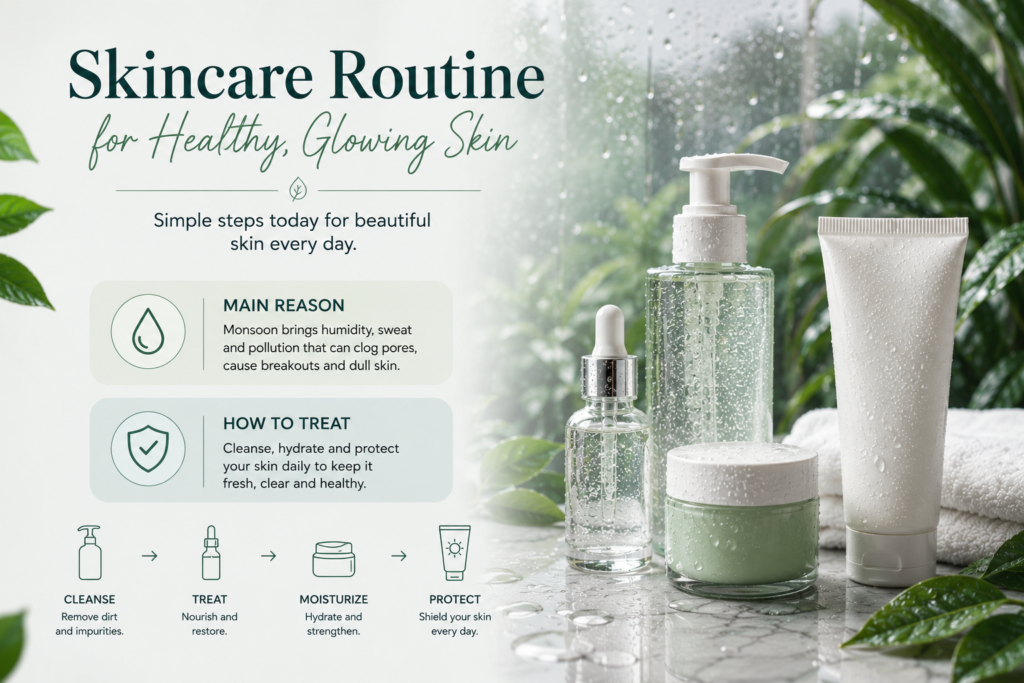
When the air gets humid, sebum production ramps up while sweat and moisture sit on the skin for longer than usual. That’s a perfect setup for bacteria and fungi to multiply. Add pollution and constant dampness into the mix, and you get the classic combination — oilier skin, more clogged pores, and a scalp that suddenly can’t hold onto a good hair day.
Here’s where people usually go wrong: they either scrub harder (which damages the skin barrier) or skip sun protection altogether because the sky looks grey. Neither actually helps.
It Might Not Be the Acne You Think It Is
This part rarely gets explained anywhere, and it’s the difference between a routine that works and one that quietly makes things worse.
Regular breakouts show up as whiteheads of different sizes, usually along the T-zone and jaw, and respond to standard treatments like salicylic acid or benzoyl peroxide.
Fungal bumps (technically Malassezia folliculitis) look completely different — small, evenly sized, itchy, and often spread across the chest and back too, not just the face. The tricky part? Heavy, oil-rich products make this worse, and typical acne creams don’t touch it. What helps instead is something anti-fungal, like a ketoconazole-based wash, paired with lighter formulas overall.
So if you’ve tried “everything” and nothing’s working, check whether it itches and looks uniform. That’s usually the tell.
| Bacterial Acne | Fungal Acne (Malassezia) | |
|---|---|---|
| Appearance | Whiteheads/pimples, varying sizes | Small, uniform, itchy bumps |
| Common areas | T-zone, jawline | Chest, back, hairline, face |
| Itchy? | Rarely | Usually yes |
| Worsened by | Skipping cleansing, touching face | Heavy, oily, occlusive products |
| Responds to | Salicylic acid, benzoyl peroxide | Anti-fungal wash (ketoconazole, zinc pyrithione), lighter formulas |
| Doesn’t respond to | — | Standard acne creams |
Morning Steps for Your Monsoon Skincare Routine
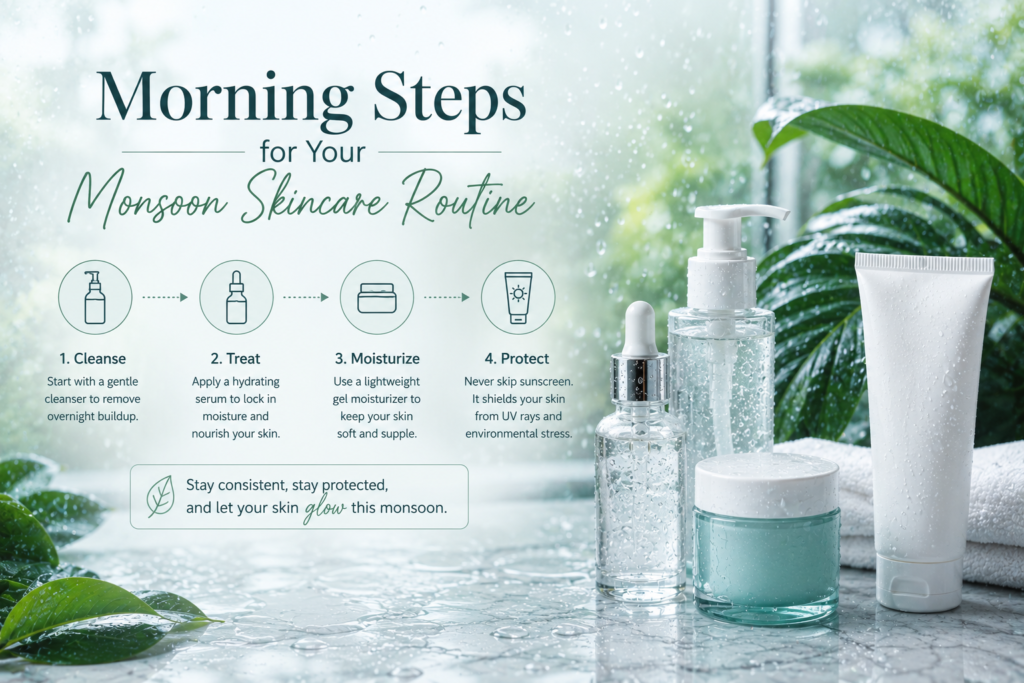
- Start with a cleanser that foams gently but doesn’t strip — heavy cream cleansers tend to leave a film in humid weather that just attracts more grime.
- If you like toner, keep it alcohol-free and hydrating. It should rebalance skin, not dry it out further.
- Reach for something gel-based and oil-free for moisture. Skipping this step because your face “feels oily enough already” is probably the single most common mistake people make in this weather — the skin just overproduces oil to compensate.
- Never leave the house without sunscreen, cloudy skies or not. UV still gets through. Look for a matte-finish, water-resistant option, SPF 30 or higher with PA+++.
Evening Steps to Complete the Monsoon Skincare Routine
Double cleansing earns its place here, especially on days you’ve worn sunscreen or makeup — an oil cleanser first, then your regular wash, clears out what plain water and soap won’t.
From there, bring in an active ingredient a few nights a week. Salicylic acid works well for standard breakouts and clogged pores; niacinamide is gentler and better if your skin leans sensitive. Using both on the same night tends to backfire, so alternate instead.
Finish with the same lightweight, gel moisturizer you used in the morning, and if you’re dealing with an active spot, treat it directly rather than overhauling your whole routine around it.
Your Hair Is Fighting the Same Battle
Skin isn’t the only casualty of monsoon weather — scalps take a hit too, and for similar reasons. A complete monsoon skincare routine really should extend to hair, since both are reacting to the same humidity and dampness.
Frizz happens because hair pulls in moisture unevenly from the air. A light, silicone-free serum on damp strands tends to do more than a heavy oil ever will.
Dandruff gets worse because a constantly damp scalp gives fungus more time to settle in. An anti-dandruff shampoo with zinc pyrithione or ketoconazole, used two or three times a week (not every day — that dries things out), keeps it manageable.
And if you’re noticing more hair fall than usual, it’s often just scalp inflammation reacting to the dampness, and it’s usually temporary. A cooling, anti-microbial oil massaged in before wash day can settle things down without leaving hair greasy.
Making Makeup Survive the Rain
- Swap out liquid foundation for something matte and water-resistant, then lock it in with a translucent powder.
- This is the season to finally use that waterproof mascara and kohl sitting in your drawer — regular formulas won’t make it through a sudden downpour.
- Go easy on cream blush and contour; they’re the first thing to slide in humidity. Powder formulas last noticeably longer.
- A setting spray genuinely changes how long your makeup holds — often the gap between three hours and eight.
Where You Live Changes Your Monsoon Skincare Routine Slightly
If you’re in a coastal city like Mumbai, Chennai, or Kochi, the humidity barely lets up, so it’s worth leaning lighter across your entire routine and adding an anti-fungal wash a couple of times a week even without visible breakouts.
In cities like Delhi, Pune, or Bengaluru, monsoon tends to come in waves rather than staying constant — so you can afford a slightly richer moisturizer on the drier days in between, while keeping sunscreen and cleansing non-negotiable no matter what.
Common Questions
Do I still need sunscreen when it’s raining or overcast? Yes — UV rays travel through cloud cover just fine. Skipping SPF during these months is one of the bigger reasons people see pigmentation show up later in the year.
Why does my skin feel oilier even though I’m moisturizing? Usually it’s the opposite problem — under-moisturizing, not over-moisturizing. Skin overcompensates when it’s dehydrated. A gel-based, oil-free formula fixes this faster than cutting moisturizer out entirely.
Is it normal to break out more even with a solid monsoon skincare routine? It happens, especially if what you’re dealing with is fungal rather than regular acne. If the bumps are itchy and uniform in size, that’s your clue to switch approaches rather than push harder with the same products.
Should I switch face washes for this season, or stick with what I use year-round? You don’t have to, but a lighter, oil-free formula during these months tends to cut down on breakouts compared to sticking with a heavier winter version.
How often should I actually use anti-dandruff shampoo? Two to three times a week is the sweet spot for most people. Daily use often backfires, drying the scalp out enough to cause more flaking, not less.
Everything you need to build this monsoon skincare routine — matte sunscreens, oil-free moisturizers, and anti-fungal washes — is on Nykaa.